
Powerful New Teaching Tool: Wellbeing Dogs in Schools
 Listed on the Victorian Department of Education Schools Mental Health Menu
See how schools are introducing a wellbeing dog to help students and staff feel more connected and engaged.
Claim Free ConsultDogs Connect has been featured in


Your free consult
Here's what you'll discover in your free consult
- Why schools are turning to a wellbeing dog as a teaching and learning tool.
- How a wellbeing dog changes the way we teach and helps embed social and emotional learning.
- The impacts schools report once a wellbeing dog is part of their community.
- The steps to integrating a wellbeing dog correctly (you'll need these to get dog-ready).
- The dog breeds we recommend, and how to source and train them.
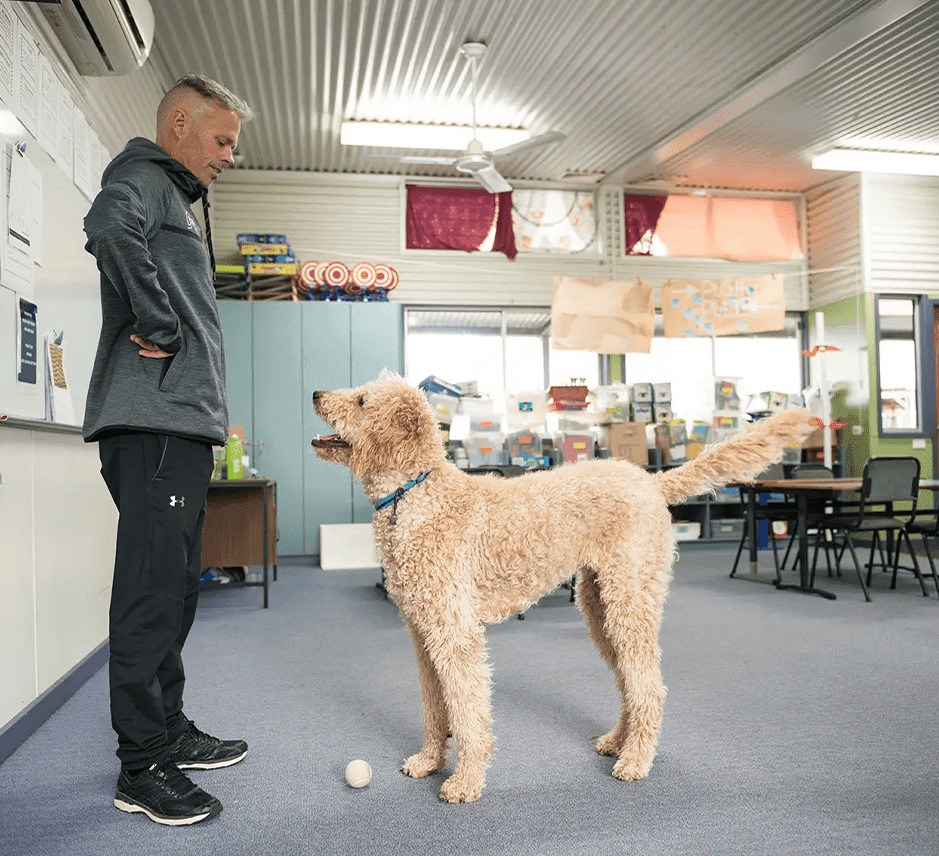
What schools tell us
With a wellbeing dog, schools report
Stronger connectedness
Between students, and between students and staff.
Students ready to learn
More engagement in the classroom, more often.
Better relationships
Empathy, awareness and emotional literacy, practised daily.
Calmer days
Fewer behavioural incidents and less time out of class.
Developed for school staff: support staff, teachers, coordinators, principals and wellbeing teams
Schools working with Dogs Connect tell us they see:
- More connectedness between students and staff.
- Students who feel ready to learn.
- Growing empathy, awareness and emotional literacy.
- Fewer behavioural incidents.
- Less time out of class.
- Improved attendance.
Unlike therapy dogs, wellbeing dogs work as teaching and learning facilitators to help improve student engagement and wellbeing.
Claim Free Consult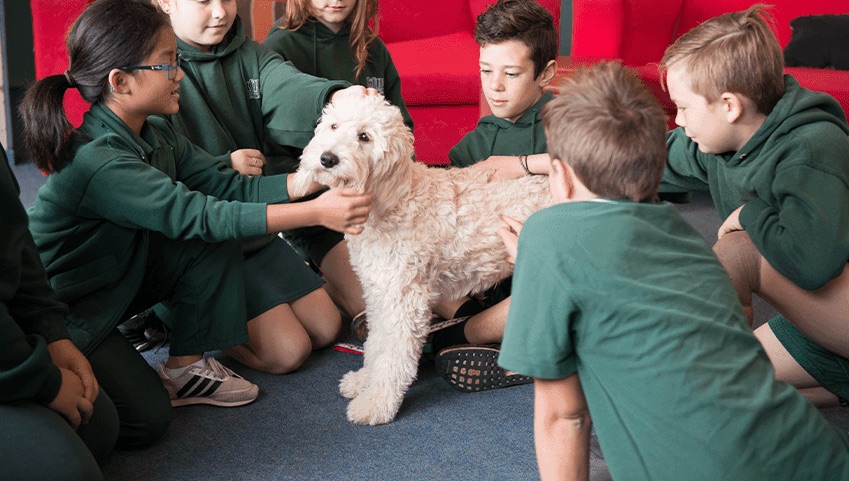
Book your free consultation
Don't just get a dog. Build a sustainable program.
You're here because you know a wellbeing dog could make a powerful difference. We're here to show you how to do it properly.
At Dogs Connect, we've helped over 400 schools and organisations across Australia build structured, sustainable wellbeing dog programs that are:
- Trauma-informed.
- Evidence-informed.
- Aligned with international standards for animal-assisted intervention.
- Focused on long-term impact, not short-term novelty.
This is not a one-size-fits-all model. It is a human-education program that puts the dog's welfare and your people's capacity at the centre.
Book Your Free ConsultationThis free consultation is perfect if you're asking:
- How do we get started safely and ethically?
- What are the legal and risk considerations?
- How do we know if our dog is suitable?
- How do we prepare our community to do this well?
- What's the difference between a wellbeing dog and a therapy dog?
We'll walk you through what's involved and how our Mentorship equips your team to lead confidently, while keeping your dog's wellbeing the top priority.
What we'll cover in your free 30-minute call
- An overview of the Dogs Connect Mentorship.
- Key foundations and readiness steps for your school.
- What makes our dog-first, human-educated model different.
- How we help you meet your compliance, wellbeing and risk frameworks.
- Your specific context, questions and goals.
You'll come away with a clear understanding of what a structured wellbeing dog program looks like, and whether it's the right next step for your school.
Book Your Free Consultation Now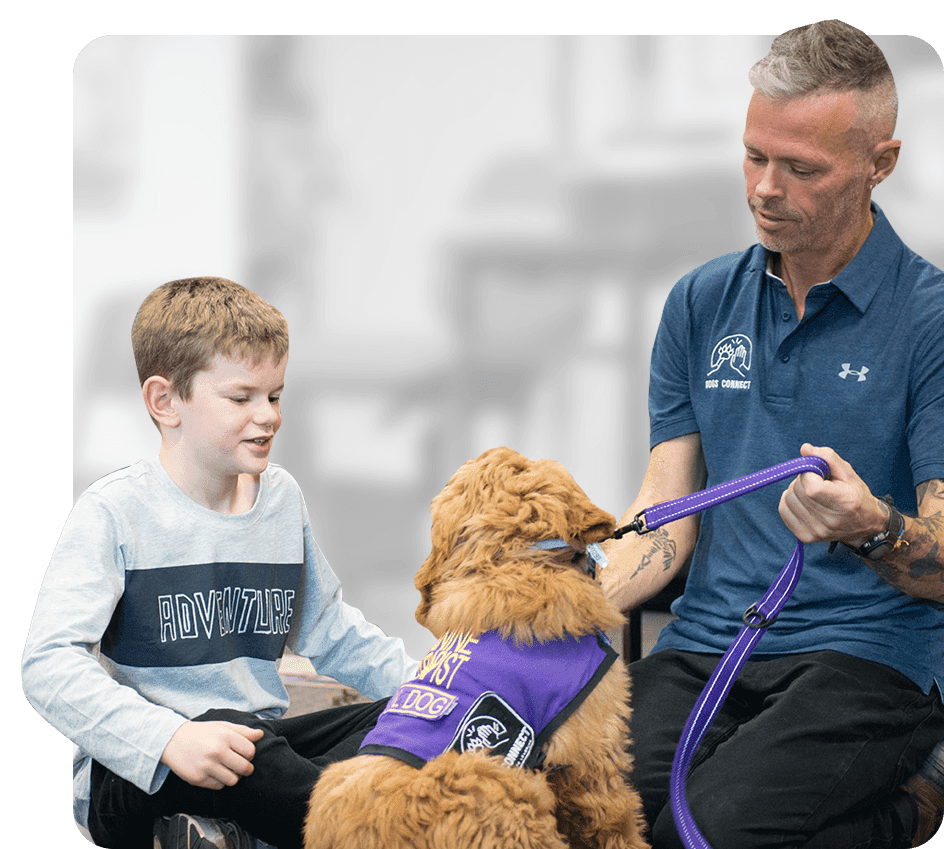
"From our very first conversation, we felt safe, informed and supported. This program gives you more than confidence. It gives you a culture shift." Principal, VIC
Why Dogs Connect
We help your people build something that lasts
Unlike drop-in programs or therapy dog visits, your dog stays with your school. Our five-phase process helps you:
- Prepare deeply
- Learn with structure
- Implement ethically
- Support the dog's welfare at every stage
- Reflect and grow through ongoing feedback and data
We'll meet you where you're at. No pressure. Just clarity, structure, and a chance to explore what's possible.
Book Your Free 30-minute ConsultationFor your people. For your dog. For your whole community.
FAQs
Questions schools ask us most
We love working with anything that has Poodle in it, generally the larger versions: Groodles, Labradoodles, Cobberdogs or Spoodles. Our rule of thumb on size is that the smaller the dog, the higher the intensity of its body language. Smaller dogs also tend to vocalise more, jumping and barking a lot more than bigger dogs.
Medium through to standard-sized dogs are generally quite passive in their body language. Anything with Golden Retriever, Labrador, or a Poodle cross of those breeds has a beautiful nature for this work. They are giving, they love the interaction, they shed very little and they trigger few, if any, allergies. They also look soft and friendly, which makes them easy for most people to warm to.
This program can be done with many kinds of dog. If you have another breed in mind, talk to us and we will happily discuss whether it is appropriate.
There are lots of different dogs, and lots of different ages, in this program. Many communities start with a mature dog that belongs to a staff member or is already part of the community.
There is a short process where we talk with you about whether the dog is appropriate in its temperament, size and breed. Generally the answer is yes. The training teaches people how to have a dog in a community so that everyone learns what they need for safety and authentic connection. It is full of positives, not just for the people but for the dog too.
We quite often start with pups. It is a beautiful model, because people grow alongside the young dog as it matures. We also often work with adult dogs from the age of one or two, and we have dogs that start at three, four or five years old. If you have a question about your own dog, bring it to the call.
We have resources that give you the information you need about outcomes, our organisation, our experience and our partnerships. If you are wondering how to take this to your leadership team, we have material you can take and use, and we are happy to talk it through with you.
No. That is not fair to the dog, and it is not fair to you. The training teaches staff to build a tight, thoroughly balanced schedule for the dog.
Dogs need interaction and exercise. They need down time and what we call positive offset time, where they recharge. They need toilet breaks, time to observe, and time to play. It is important that people learn how to build a day that fits the community and fits the dog, because the wellbeing of the dog comes first.
Part of balancing a dog's working life is making sure people build authentic connections with it. That involves a lot of fun and game-based activity, and a lot of physical connection: patting, sitting with the dog, being around it.
The training teaches you how to do this at every level. It is really important that we honour what these dogs offer. We respect it, we are thankful for it, and we need to make sure they love going to work every day.
Not every staff member needs to enrol. We enrol what we call the core team, which ranges from 2 to 18 staff depending on the size of the community.
The core team delegates, oversees and drives the program because they want to and they are passionate about it. Supported by our team, they pass the training on naturally to colleagues, caregivers and students through the opportunities that come up in your community.
It is a really important question and it deserves to be respected and talked through properly. Fear is not something we should ever attempt to change in people. Allergies are very real. Religions, cultures and personal differences mean that not everyone loves dogs.
The answer is to have those conversations respectfully and to make it clear that people can still be included. You do not need to touch the dog, or be in the dog's space, to have an important role. Invite people to see the program from a distance first, and make it clear they will never be forced into an interaction with a dog.
Dogs Connect is listed on the Victorian Department of Education Schools Mental Health Menu as a Tier 1 (whole-of-school) wellbeing program.
The Dogs Connect Online Program is a quality-assured program in the NSW Department of Education's Student Wellbeing external programs catalogue, under the theme Sense of Belonging.